
Technical Notes
OEM Solvent TIJ Cartridges: A Private-Label Buyer's Guide
OEM for solvent TIJ cartridges is our tested cartridge with your label, carton and documentation. ODM adds ink development, with sampling and validation before any quantity order. Here is what each covers, what changes and what cannot, and where your money actually goes.
What OEM and ODM mean for a cartridge
OEM for a solvent thermal inkjet (TIJ) cartridge means one thing: the manufacturer’s cartridge with your label on it. Same HP45-format body, same 42 ml industrial fill, same mild-solvent ink, same open non-encrypted chip, packed and labelled as your brand. Nothing inside changes. You are buying our tested product and putting your name on the box.
ODM goes one step further: an adjustment to the product itself — realistically, ink tuning for a substrate your customers print on heavily — developed and validated with you before any quantity order is placed. That is a development project, not a label swap.
Private-label manufacturing is exactly that and nothing more: the same cartridge, a different label, a different carton. It is not a cheaper product made to a lower standard, and it is not a second line.
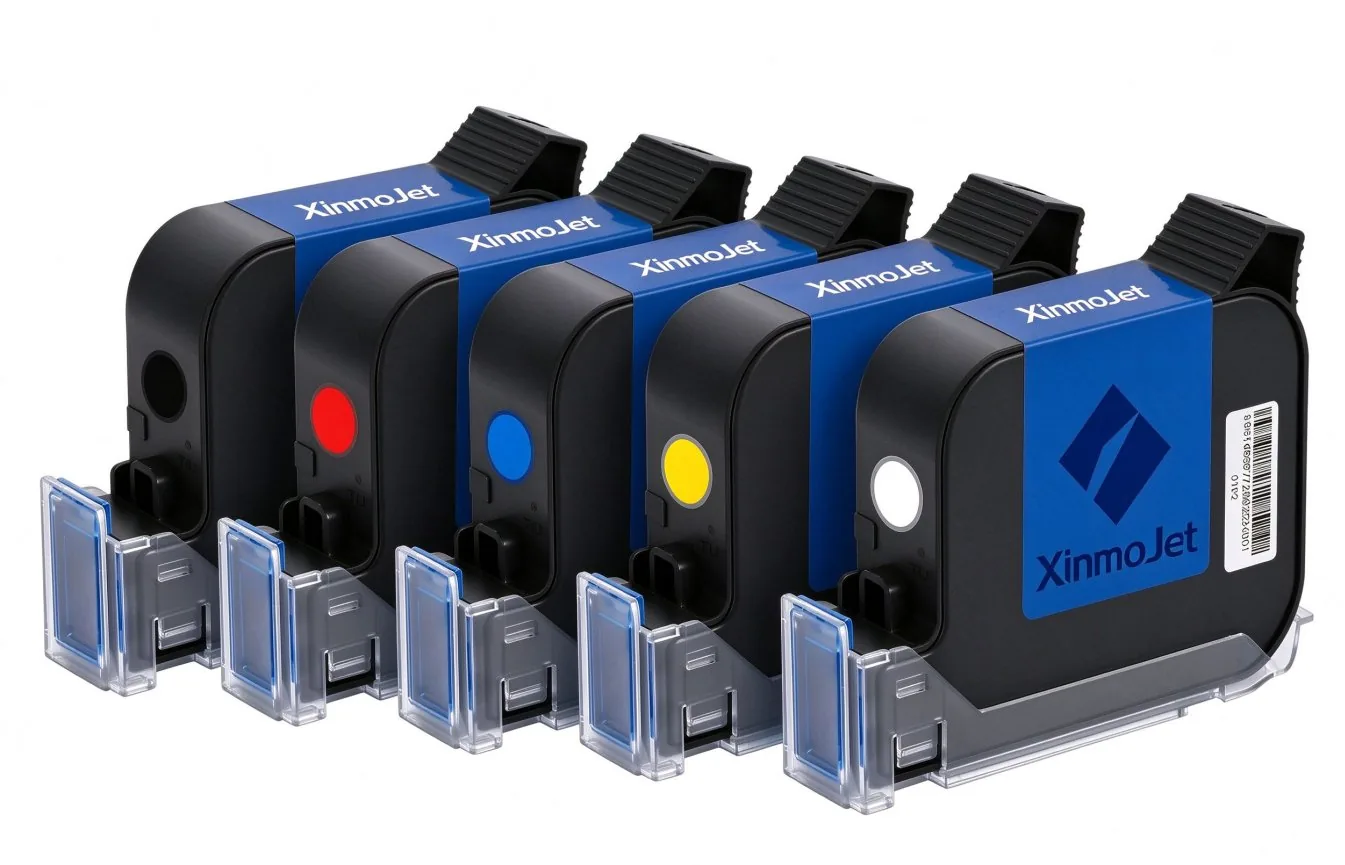
What neither term means is a trader buying cartridges and sticking your label on them in a warehouse. That happens in this market, and it is the reason this article exists. An OEM supplier should be able to show you the line and the testing under their own roof. If they cannot show formulation, filling, sealing and testing themselves, you are not buying OEM. You are buying relabelled stock with an extra margin in the middle and nobody accountable when a batch drifts.
If you are new to the category, what a solvent TIJ cartridge is covers the basics. If you want to see the line your labelled cartridges will come off, and the six stations that will also make your OEM batch, read how the sealed assembly is built and tested.
What you can change: label, carton and documentation
Label and packaging is the core of an OEM project, and it is routine. Your brand name and logo on the cartridge label, your carton design, your language on the box and in the documents, your part numbers cross-referenced to ours.
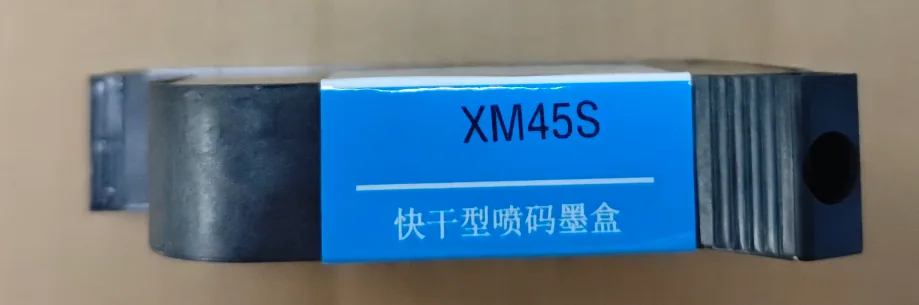
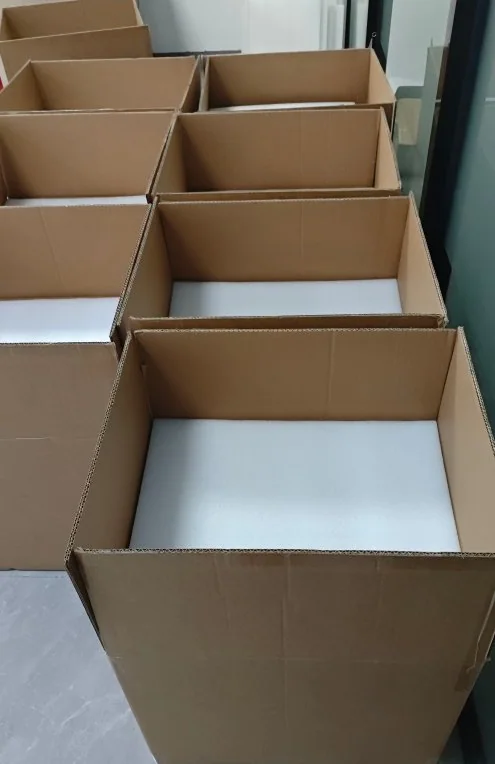
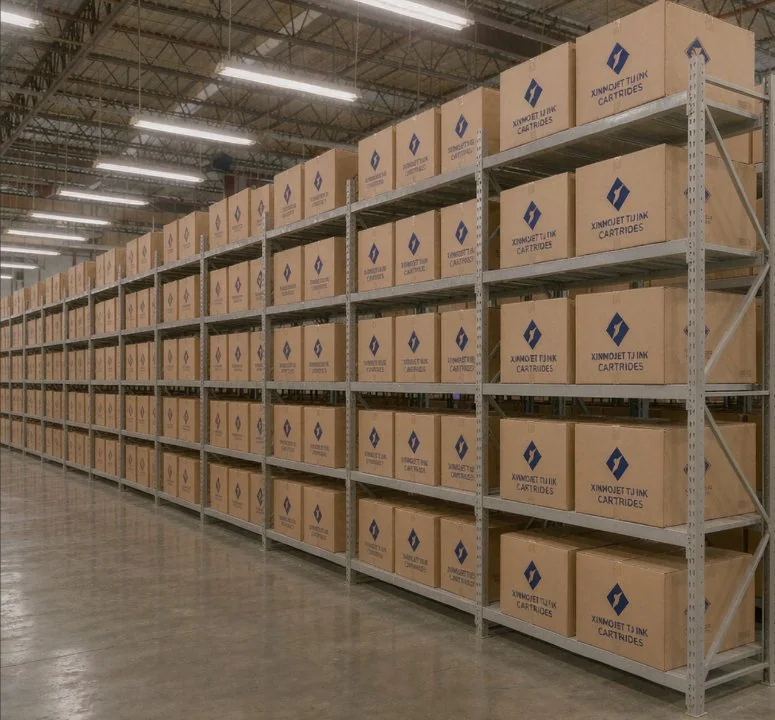
One practical note that catches people out: cartridges ship 160 to a carton as standard, and custom carton printing is tied to carton quantities rather than cartridge quantities. Confirm the packaging minimum when you specify it, in writing, because it can differ from the cartridge minimum.
Documentation is equally straightforward and often forgotten until late. Safety data sheets, declaration documents and user instructions in your language, under your brand, issued against the same product specification. Ask for them early. A distributor selling into food-adjacent packaging or into pharma channels needs the paperwork before the first order, not after it.
Ink adjustment is possible, as an ODM project rather than an OEM one. ODM ink adjustment is development work with a validation record at the end of it, which is why it cannot be quoted like a label change. Our standard solvent ink is a mild-solvent formulation, placed by our factory in the HP 2580 system direction — a system correspondence, not a specification match, as set out in HP 2580 vs HP 2590 vs Xinmo XM-45S. If your application needs the ink tuned, because a substrate needs a stronger bite or a line speed needs a different drying balance, that is developable. But it is development: formulation work, sample rounds and validation on your material. It is never done by description alone, and a supplier who agrees to an ink change without asking for your substrate and your test method is not developing anything. They are guessing.
A rule of thumb worth keeping: if a change can be verified by looking at the box, it is OEM and it is fast. If it can only be verified by printing, it is ODM and it needs samples. Hold every supplier to that distinction, including us.
What does not change: the cartridge core
The HP45-format body, the 42 ml fill, 300 nozzles per row, 12.7 mm or 25.4 mm print width on the XM-45S-127 and XM-45S-254, native 300 dpi up to 600 dpi depending on print mode — that is the platform. You can read the full specification on the solvent cartridge page.
Changing the core means revalidating everything: fill weight, sealing, print quality, printer compatibility across machines you do not control. For a consumable, that is rarely what an OEM buyer actually wants. The value of OEM is the opposite — a proven, tested core with your brand on it, so your customers get consistent cartridges and you get the margin and the brand equity.
This is also where a quote gets honest or vague. A supplier who says “we can make it any way you want” is either quoting you a new development project without telling you, or planning to relabel whatever is in the warehouse. Both cost more later than they save now.
The OEM process, step by step
Use this as a checklist against any proposal. A missing step is information.
1. Inquiry with a real specification. “I want OEM cartridges” is not a specification. The useful inquiry states the product, an estimated annual quantity, your label and carton requirements, your documentation language, your target markets and your delivery rhythm. The more you supply up front, the fewer rounds the project takes.
2. Quotation against that specification. OEM pricing is confirmed per specification, because it depends on what changes and on quantity. Our public price for the standard cartridge is USD 28 for 12.7 mm and USD 58 for 25.4 mm, published on the pricing page. OEM is quoted against your spec sheet, not lifted from that list. A supplier who quotes OEM from a price list without asking what changes has not understood the project.
3. Artwork proof. Before any production quantity you approve the artwork: cartridge label, carton print, documentation. This is the cheapest place in the whole project to catch an error — a wrong model designation or a missing market marking costs a reprint of the artwork here, and a reprint of the carton later.
4. Sampling. You receive labelled samples in the exact configuration you approved. For a label-only project, samples confirm the label, the packaging and that the cartridge inside is the standard tested product. For an ODM ink project, the samples are the development rounds themselves, each round tested and each result feeding the next.
5. Your validation. This is the step buyers skip most often and the step that matters most. Print the samples on your materials, at your line speed, in your environment. The adhesion guide is written for exactly this: what fails on which substrate, and what to check before blaming the ink. Our standing recommendation, for us and for every supplier you talk to: sample first, validate on your material, then discuss quantity.
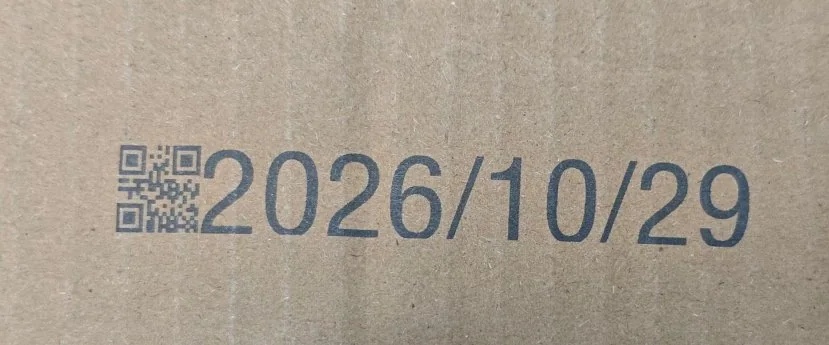
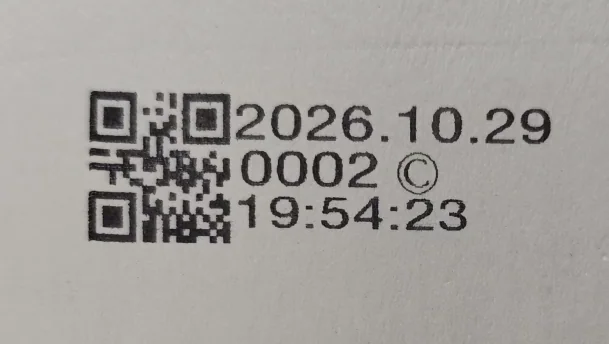
6. Mass production under the same QC. Your OEM quantity runs the identical six stations as our own brand: formulation and filtration, body preparation and chip mounting, vacuum filling to 42 ml, sealing and capping, then 100% weighing plus visual inspection plus print test, then packing with traceability. OEM does not mean lighter QC. It means you are entitled to the batch records — fill weights, test results, traceability codes. Ask for them.
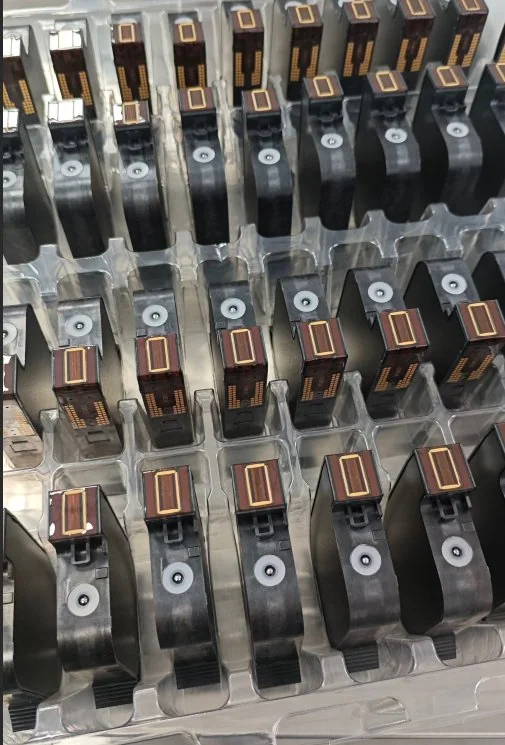
7. Shipment and reorder. Standard product ships within 3 working days of payment. OEM timing is confirmed per project, because packaging and quantity change the schedule, and we would rather confirm it than publish a promise that does not hold for a custom carton. Agree the reorder rhythm early: OEM works best as a rolling programme, not a one-off order.
MOQ and cost logic
The standard minimum order is 160 cartridges, one carton — the same minimum as our own brand. At the public price of USD 28–58 depending on model, a single-carton order lands between USD 4,480 and USD 9,280. OEM adds exactly one variable to that arithmetic: the cost of your customisation, quoted per specification.
The wider cost reasoning — why unit price is not the cost, how to run the cost-per-thousand-prints maths, the costs buyers forget, and the questions to ask about price — is in how much a solvent TIJ cartridge really costs. Everything there still applies to an OEM order.
Three things buyers get wrong about OEM cost, in order of how often they come up.
The label is cheap; the setup is not. Artwork, carton print setup, plate or plate-less preparation, documentation drafting — these are fixed costs spread across your quantity. That is why OEM unit economics improve with volume, and why a serious supplier asks about your annual quantity in the first exchange.
Custom packaging can move the MOQ. The cartridge minimum is 160. If your carton has its own print-run minimum, the effective first-order quantity follows the packaging, not the cartridge. Get both numbers in writing before artwork is approved, because discovering the second one after approval is the expensive order to discover it in.
ODM development cost is separate from unit cost. Ink tuning, sample rounds and validation testing carry their own cost, and a serious supplier says what it does and does not include before work starts. “Free development” usually means no development was done.
Five questions to ask an OEM supplier
These are adapted from the manufacturer evaluation checklist we publish, narrowed to OEM specifically.
Can I see the line? Formulation, filling, sealing, testing — under your own roof, not a partner’s, not a video from somebody else’s factory. A manufacturer shows stations. A trader shows a warehouse.
Is my OEM quantity tested the same way as your own brand? The answer has to be yes, with specifics: every unit weighed, visually inspected, print-tested. “Same as standard” without the specifics is a slogan, not a control.
What exactly changes for my version, documented? Label, carton, documentation, and for ODM the ink specification with its validation record. If it is not on the spec sheet, it was not agreed.
What are the two minimums? The cartridge minimum and the packaging minimum. A supplier who can state only one has not costed your project.
What happens when a batch is bad? Traceability per batch, a defined complaint route and a named person accountable. Ask before the first order, not after the first failure.
A supplier who answers all five concretely is worth sampling from. One who waves any of them away is telling you how the relationship will work when something goes wrong.
Questions buyers ask about OEM solvent TIJ cartridges
Do you offer private-label (OEM) solvent TIJ cartridges?
Yes. Our standard XM-45S solvent cartridge — HP45 format, 42 ml industrial fill, mild-solvent ink, open non-encrypted chip — with your label, your carton and your documentation. The process, the MOQ and how timing is confirmed per project are set out on the OEM/ODM page.
What is the minimum order for OEM?
160 cartridges, one carton, is the standard MOQ and it is the same as our own brand. Custom carton printing can carry its own print-run minimum, so confirm both the cartridge MOQ and the packaging MOQ in writing before you approve artwork.
Can the ink be adjusted for my application (ODM)?
Yes, as a development project: formulation adjustment, sample rounds and validation on your material before any quantity order. It is never agreed by description alone — we will ask for your substrate, your line conditions and your test method before anything is proposed.
How long does an OEM project take?
Label-only OEM moves at the speed of artwork approval plus production scheduling; standard product ships within 3 working days of payment, and OEM timing is confirmed per project rather than published as a promise. ODM ink projects take as long as the sample and validation rounds take.
Will my OEM cartridges be tested the same as your own brand?
Yes. Every unit goes through the same six stations: formulation and filtration, body and chip, vacuum filling to 42 ml, sealing and capping, then 100% weighing plus visual inspection plus print test, then packing with traceability. Batch records are available on request.
How do I start an OEM project?
Send a real specification: product, estimated annual quantity, label and packaging requirements, documentation language and target markets. Start from the OEM/ODM page or contact us directly, and plan to validate samples on your own material before any quantity order.
What this changes before you sign
OEM for solvent TIJ cartridges is simple when it is honest. You take a proven cartridge — HP45 format, 42 ml, mild-solvent, print-tested on every unit — and put your brand on it. ODM adds ink development, done properly, with samples and validation on your own material. Either way the sequence is the same: specification, quotation, artwork approval, sampling, your validation, then mass production under identical quality control. The standard minimum is 160 cartridges; custom packaging may set its own. Price follows the specification, not the price list.
The one thing to carry into any OEM conversation, with us or anyone else: the supplier should be a manufacturer first and a label printer second. Ask to see the line, ask for both minimums, validate samples on your own material, and never place a quantity order against an unvalidated sample.
If the answer to any of that is a shrug, you have learned something cheap. Everything else is detail, and the detail lives on our OEM/ODM page, our manufacturer page, and our pricing page. When you are ready to start, send us the specification and we will quote against it.
Related reading
- 13 November 2026
How to Check TIJ Cartridge Compatibility Before Ordering
Most compatibility problems are information problems: the buyer sends a part number, the supplier answers the …
- 5 November 2026
Solvent vs Water-Based TIJ Ink: What Decides Which One You Need
Water and solvent are two carriers, and the carrier decides which surfaces an ink will wet, how long it takes …
- 31 October 2026
Solvent TIJ Cartridge Storage, Shelf Life and Decap Time Explained
Store your solvent TIJ cartridge sealed, out of direct light, at room temperature, with the original cap on wh…
Want this confirmed on your own material?
We print on samples of your actual substrate and send them to you. Send the material, the line speed and the code content, and we will tell you honestly whether the fault is the ink, the surface or the line layout.