
Technical Notes
How to Check TIJ Cartridge Compatibility Before Ordering
Most compatibility problems are information problems: the buyer sends a part number, the supplier answers the part number, and nobody checks your machine. Here is what to send instead, the three mismatches behind most wrong orders, and how to read the reply.
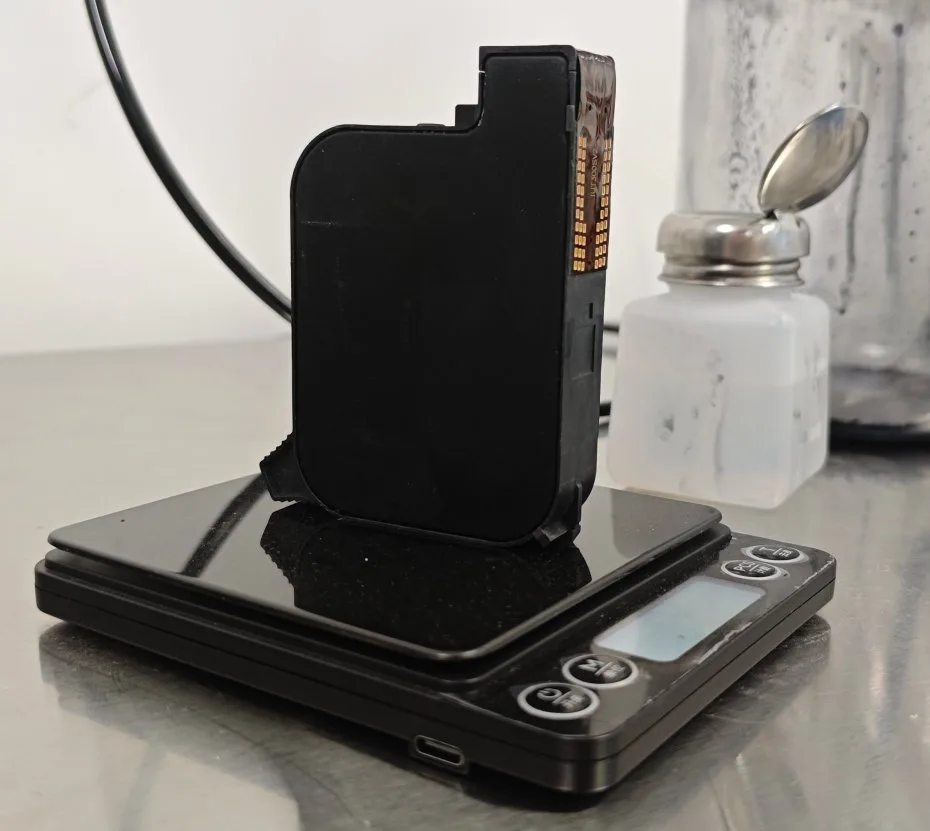
The compatibility answer is decided before you order, and rarely by the cartridge
A compatibility failure is usually described afterwards as “the wrong cartridge arrived”. Look at the same event from the supplier’s side and it reads differently: a part number was sent, the part number was quoted, and neither party ever described the machine. The cartridge that arrived was exactly the one on the order.
So before the question “which cartridge fits my line”, there is a smaller and more useful one: have you given anyone enough to answer it? Five details decide almost every case. When they are on the table, compatibility is a short conversation. When they are missing, it becomes a sample cycle, a return, or a line that stops on a Friday afternoon.
A thermal inkjet (TIJ) cartridge is a consumable that carries its own printhead, which is why fit is a question about the machine rather than about the ink alone: print width, chip state and the contact arrangement all have to line up before ink quality matters at all.
This note is about that first step — what to send, what the three common mismatches are, and how to tell a real answer from a price. It is deliberately not about how to run the trial once samples arrive; that is a separate job, covered in how to trial a cartridge before you commit to a supplier.
The five details that decide the answer
Every enquiry we can answer on the first reply contains these. Every enquiry that turns into three rounds of email is missing two or three of them.
| What to send | What it settles | What people usually send instead |
|---|---|---|
| The machine’s plate: brand, model, serial | Which platform the cartridge has to satisfy | “It is a coding machine” |
| A photograph of the cartridge you are replacing, label legible | Family, print width, chip state, ink type | A part number typed from memory |
| The substrate, named specifically | Which ink system can even be considered | “Plastic” or “carton” |
| Line speed, and the size of the code | Drying budget, and whether the width is enough | Neither |
| Whether the line runs continuously or stops and starts | Decap behaviour, which is a different spec | Nothing |
Two of these are worth dwelling on, because they are the ones buyers treat as optional.
A photograph of the label is not lazy, it is more accurate than a part number. Labels carry the print width, the fill volume, the ink designation and often a batch code, and a photograph transmits all of it without transcription errors. We have had buyers send a number that belonged to a cartridge two generations back, because it was the one still sitting in the ERP field. The photograph settles that in one glance.
“Plastic” is not a substrate description. A coated PET film, an uncoated LDPE shrink sleeve and a rigid PVC bottle are three different surfaces with three different surface energies, and a solvent that wets one can bead on another. If the material has a coating, the coating is the surface that matters, not the base film underneath it. The same caution applies to board: an uncoated kraft carton and a varnish-coated one behave nothing alike, and this is the single most common reason a code “worked in the lab”.
Three mismatches behind most wrong orders
When a cartridge genuinely does not fit, it is almost always one of these three, in this order of frequency. None of them is visible from a part number alone.
The part number matches but the chip does not
Cartridges in the HP45 format family are not one part. They share a body shape and a contact arrangement, and differ in what the chip does — whether it carries a remaining-ink counter, whether it is write-protected, and what the machine does when it reads a state it does not expect. A cartridge can be dimensionally correct, print correctly on the bench, and still be refused by the printer, or accepted and then stop mid-shift.
This is why “compatible with HP45” is not an answer you can order on. It names a family, and the family contains more than one electrical behaviour. Ask the supplier to state, in writing, what the chip state is and what happens on a machine that expects a different one. We publish ours as open chip and still ask for a sample before calling anything confirmed, because the machine in front of you is the only authority. Model numbers appear in this article only to identify a format: XinmoJet is an independent manufacturer of cartridges and inks, not connected to HP.
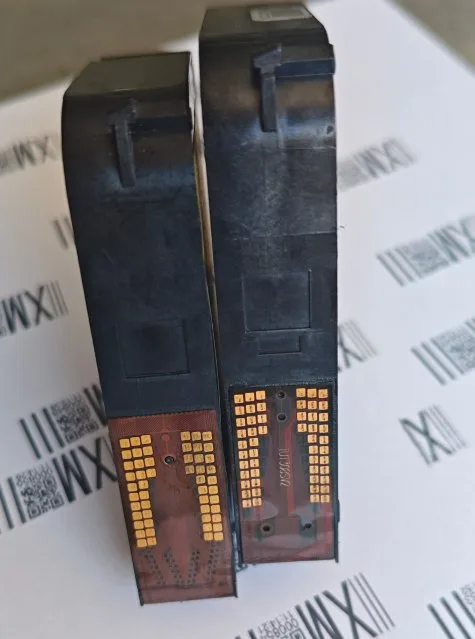
The model is right but the print width is not
Two cartridges can be the same family, the same ink and the same chip, and still not be interchangeable, because one prints 12.7 mm and the other 25.4 mm across. If your code block is wider than the narrower one, the result is not a smaller code — it is a stitch line, a second head, or a code that has to be split. Width is a mechanical decision that has to be made before price, not after. The reasoning is set out in choosing between 12.7 mm and 25.4 mm, and the two widths are not a quality ladder.
Both are right and the substrate changed
The most expensive version, because nothing on the paperwork is wrong. The cartridge is the same one that has run for two years, and then a packaging change — a new coating, a switch from one film gauge to another, a move to a brighter board — quietly removes the surface the ink was formulated for. The code prints, looks acceptable for ten seconds, and fails a rub test at the end of the line.
If a packaging change is planned, that is the moment to re-check compatibility, not the moment after the first pallet is rejected. And if the code is failing on a material that used to work, the useful question is not “is the cartridge faulty” but “what changed about the surface” — the diagnostic order for that is in why adhesion fails, in the order worth checking.
The enquiry block you can copy and send
Most buyers write a polite paragraph and leave the specification out. Sending the specification first is faster for both sides, and it makes the reply comparable between suppliers — which matters more than it sounds, because it is the only way to compare two quotes that are answering different questions.
You can paste this into an email:
We are replacing cartridges on [machine brand + model, serial if available]. Photograph of the current cartridge label attached. Substrate: [specific material, including coating or film type], [thickness or grammage]. Line speed: [units per minute]. Code: [lines × height in mm], [static or variable data]. The line runs [continuously / stops and starts, average duty cycle]. We need: [print width], [ink system if known], [chip state the machine expects, if known]. Please confirm what fits, and state what you cannot confirm without a sample.
That last line is the one worth keeping. It gives the supplier a way to be honest without sounding evasive, and it produces a more useful reply than asking for a guarantee. Anyone who answers “100% compatible” to that block has told you something about their sales process, not about your machine.
How to read the reply you get back
A useful answer has a shape. It names the width, the chip state and the ink system, and then it separates what was confirmed from what was assumed. It usually contains at least one question back, because the five details rarely cover everything — ambient temperature in an unheated hall, a printhead that is two years old, a conveyor that surges.
Three replies that should make you slow down:
- A price with no questions. It answers the part number you sent, not the machine you have.
- “Fully compatible with all HP45 machines.” No cartridge is. The statement is a category claim dressed as a specification.
- A confirmation that does not mention the chip state at all. Chip behaviour is where the surprises live, and silence there is not reassurance.
The reverse also holds: a supplier who says “this width will fit, the chip state is X, and the ink is the part we cannot confirm until we see your material” has given you a more reliable answer than one who confirms everything. That is not a weaker answer, it is a narrower and therefore more trustworthy one.
What “best” means before those five details are settled
Buyers arrive with the phrase “best TIJ ink cartridge” already formed, and it is a reasonable thing to want. The problem is that it needs a denominator. Best at what — lowest cost per code that still scans, longest decap on a line that stops, fastest dry on film at speed, or widest tolerance for a material nobody has quite specified?
Those four questions have four different answers, and they are not ranked against each other. A cartridge that is the right answer at 40 packs a minute on coated board can be the wrong answer on a shrink sleeve that sits idle between shifts. This is also why we do not publish a ranking: a list that puts one cartridge first is a list that has quietly chosen a denominator for you, and it is rarely yours.
So the useful order is: settle the five details, reduce the field to the one or two cartridges that can physically do the job, and only then compare them on price, on support and on how they behave when something goes wrong. If the field has more than two candidates at that point, one of the five details is still vague. The comparison logic for that second stage — including why the brand name on the box is a poor proxy for who made the ink — is in who really makes the best solvent TIJ cartridges.
If you cannot find the cartridge you are replacing
Common, and not a dead end. Three ways through it, in order of speed:
Photograph the machine plate. It identifies the platform, which is more decision-relevant than the last consumable bought for it. The plate usually carries a model that maps to a print width and a chip expectation.
Check the purchase history rather than the memory. The last invoice, the packing list, or the ERP line will have a part code and often a description with the width in it. A code from two generations back is still a starting point, and easier to correct than a guess.
Look at the cartridge itself. Print width is measurable with a ruler against a test print; fill volume is usually printed on the label; the ink designation is often a letter code. That is enough to ask a specific question rather than a general one.
If the platform is one of the widely used solvent systems, our model cross-reference for the 2588, 2580, 2590 and HP45 formats will usually place it in one or two lines, and the compatibility selector will narrow the substrate-and-width question in a few clicks. Neither replaces the five details, but both shorten the first email.
What happens after the answer
Once the mechanical and electrical questions are settled, one question remains that no form can answer: will this ink hold on this material, at this speed, through the handling your pack goes through afterwards. That is what the sample is for — not to confirm that the cartridge fits, which you have already established, but to test the part that was never a compatibility question in the first place.
We print on samples of the actual material and send them back, because a code that rubs off on the third pallet is a failure that a datasheet cannot predict. If you want to start with the five details, the contact form takes them; if you already have a substrate question, say so and we will tell you what we would test first.
The short version
Compatibility is not a property of a cartridge, it is a match between a cartridge and a machine plus a material. You cannot check it with a part number, a family name, or a promise. You can check it in one email, if the email contains the machine, the cartridge, the substrate, the speed and the duty cycle — and then you can judge the answer by whether it separates the confirmed from the unconfirmed.
Frequently asked questions
Is “compatible with HP45” enough to order on?
No, and it is not meant to be. HP45 describes a cartridge family, not a single part. Within that family there are different print widths, different chip states and different ink systems, and a machine that accepts one will not necessarily accept another. Treat the family name as the start of the conversation, then settle width, chip and ink from the details above.
I do not have the old cartridge any more. What do I send instead?
A photograph of the machine’s plate is the next best thing, and often better, because it identifies the platform rather than the last consumable bought for it. Failing that, the original purchase order, the ERP part code, or the brand and model of the coder itself will usually narrow it to one or two options — which is enough to ask a precise question.
How long should a compatibility answer take?
If you have sent the five details, a supplier who knows the platform can answer within a working day: this width, this chip, this ink, and here is what we are not sure about. An answer that arrives in five minutes without a single question back is usually a price, not a compatibility check.
Can you confirm compatibility before I send a sample?
We can confirm the mechanical and electrical fit from the details — width, chip state, cartridge family, the platform it goes into. What no supplier can confirm from a form is whether the ink will hold on your actual material at your actual line speed. That is what the sample is for, and we would rather say so than call it confirmed.
Why will you not just tell me which cartridge is best?
Because “best” needs a denominator. Best at 40 packs a minute on coated board, best on shrink film that stops and starts, best at the lowest cost per readable code — those are three different cartridges. Once the five details are on the table, the ranking usually collapses to one or two candidates, and the choice becomes obvious.
Related reading
- 8 October 2026
How to Trial a TIJ Cartridge Before You Commit to a Supplier
A supplier demonstration and your production line are different tests, and the gap between them is where most …
- 5 November 2026
Solvent vs Water-Based TIJ Ink: What Decides Which One You Need
Water and solvent are two carriers, and the carrier decides which surfaces an ink will wet, how long it takes …
- 1 November 2026
OEM Solvent TIJ Cartridges: A Private-Label Buyer's Guide
OEM for solvent TIJ cartridges is our tested cartridge with your label, carton and documentation. ODM adds ink…
Want this confirmed on your own material?
We print on samples of your actual substrate and send them to you. Send the material, the line speed and the code content, and we will tell you honestly whether the fault is the ink, the surface or the line layout.